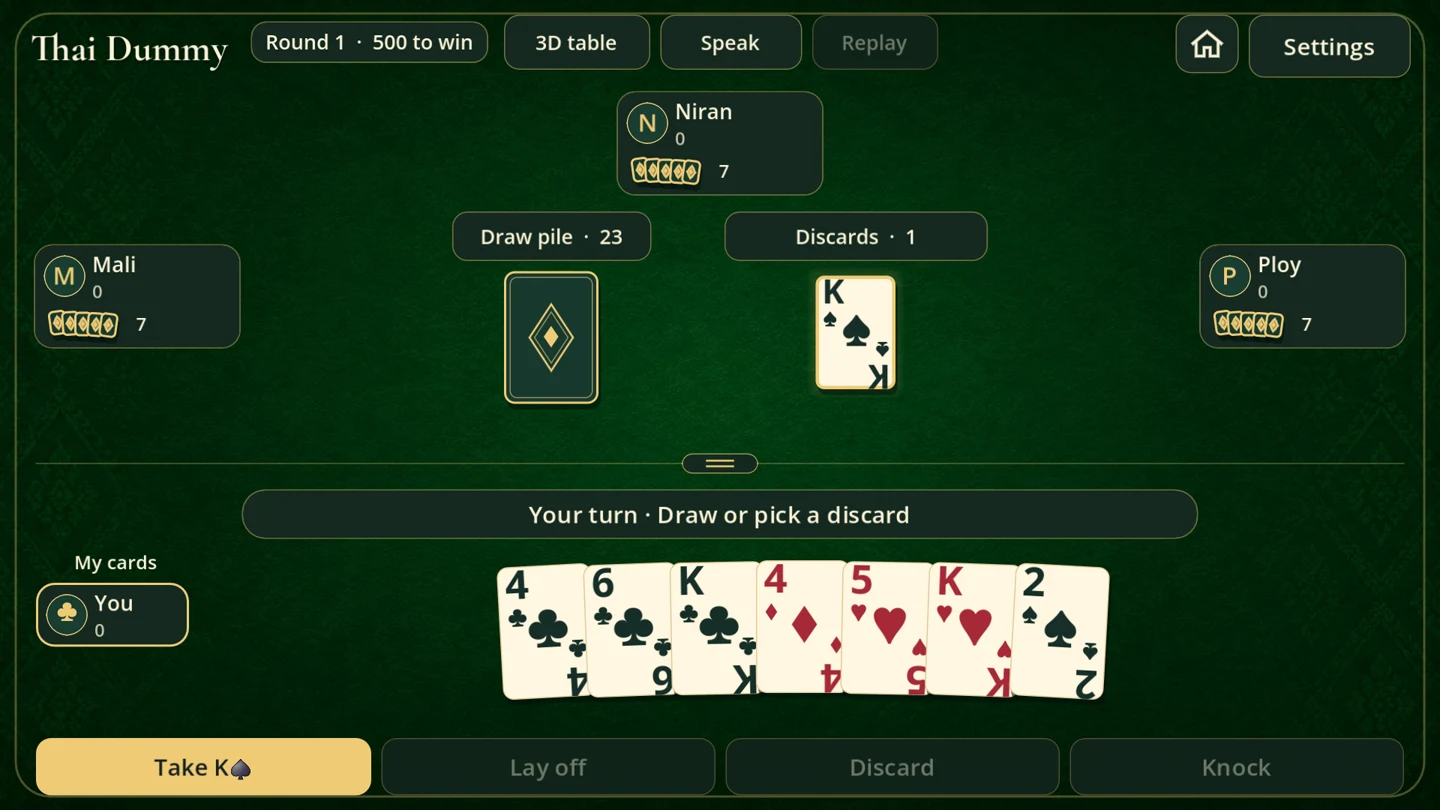
The aim and the deal
Put cards on the table in scoring groups. At the default four-seat table, each player starts with seven cards. Play one round or race to a target score.
Play passes to the right by default. In a points race, a tie for first place means playing another round.
Draw or take a discard
Start your turn by drawing one face-down card or taking a legal face-up discard. With deep pickup enabled, take every newer card above the one you choose. Use your chosen card immediately.
A normal discard pickup must make a new group with a card you already held. Under default rules, taking directly onto an existing group is allowed only if you knock that turn.
Build a set or a run
A set has three or four cards of the same rank in different suits. A run has at least three consecutive cards of one suit. Q–K–A is a run in this game. A–2–3 is not.
In two-deck games, a group can contain only one copy of each exact card.
Open and add to a group
Under the default rules, open your first group by taking a discard. On later turns, draw or take first, then add a fitting card. For example, add 9♦ to 6♦–7♦–8♦.
The house rules decide whether you can add to another player’s group. End your turn with a discard unless you knock.
Knock and count the score
When you have a group of your own and one card left after laying the others, turn that last card face down to knock. Score the cards you laid, deduct cards still in hand and any penalties. A knock adds 50 points before multipliers.
Cards 2–9 normally score 5 each, 10–K score 10 and aces score 15. When the stock runs out, the next player must knock immediately with a discard pickup or the round is scored.
Special cards and house rules
2♣ and Q♠ are worth 50 points each. Under standard rules, discarding a card that fits a group already on the table costs 50 points. The host can change pickup rules, penalties and other house rules before the round.
With both bonuses enabled, knocking without having opened on an earlier turn and knocking with one suit each double your score. Together they multiply it by four.
 GigaInvent